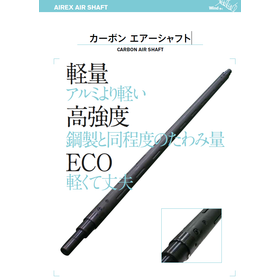
Lighter than aluminum. Comparable deflection to steel. Lightweight and durable.
Lightweight Design
By using carbon (CFRP) instead of steel for the main body material of the shaft, it is possible to reduce the weight to about half of the original mass. *This comparison is only for the main body part excluding the shaft end.
High Strength with Low Deflection
When aluminum alloy is used to reduce weight, the strength significantly decreases compared to steel, and deflection may increase, making it unsuitable for high-load applications. In the case of carbon (CFRP), the reduction in strength is minimal, and the increase in deflection is also low, allowing it to be suitable for high-load applications similar to steel.
Low Inertia and Eco-Friendly
The GD2 (inertia) of carbon (CFRP) shafts is about half that of aluminum alloy and about one-fifth that of steel. This means that energy consumption for rotational motion can be reduced, making it an eco-friendly air shaft that matches the times.
Beautiful Appearance
The outer surface is wrapped with a lattice-patterned cross, resulting in a beautiful finish. Additionally, CFRP has high corrosion resistance and does not rust.
- Company:藤川伝導機
- Price:Other